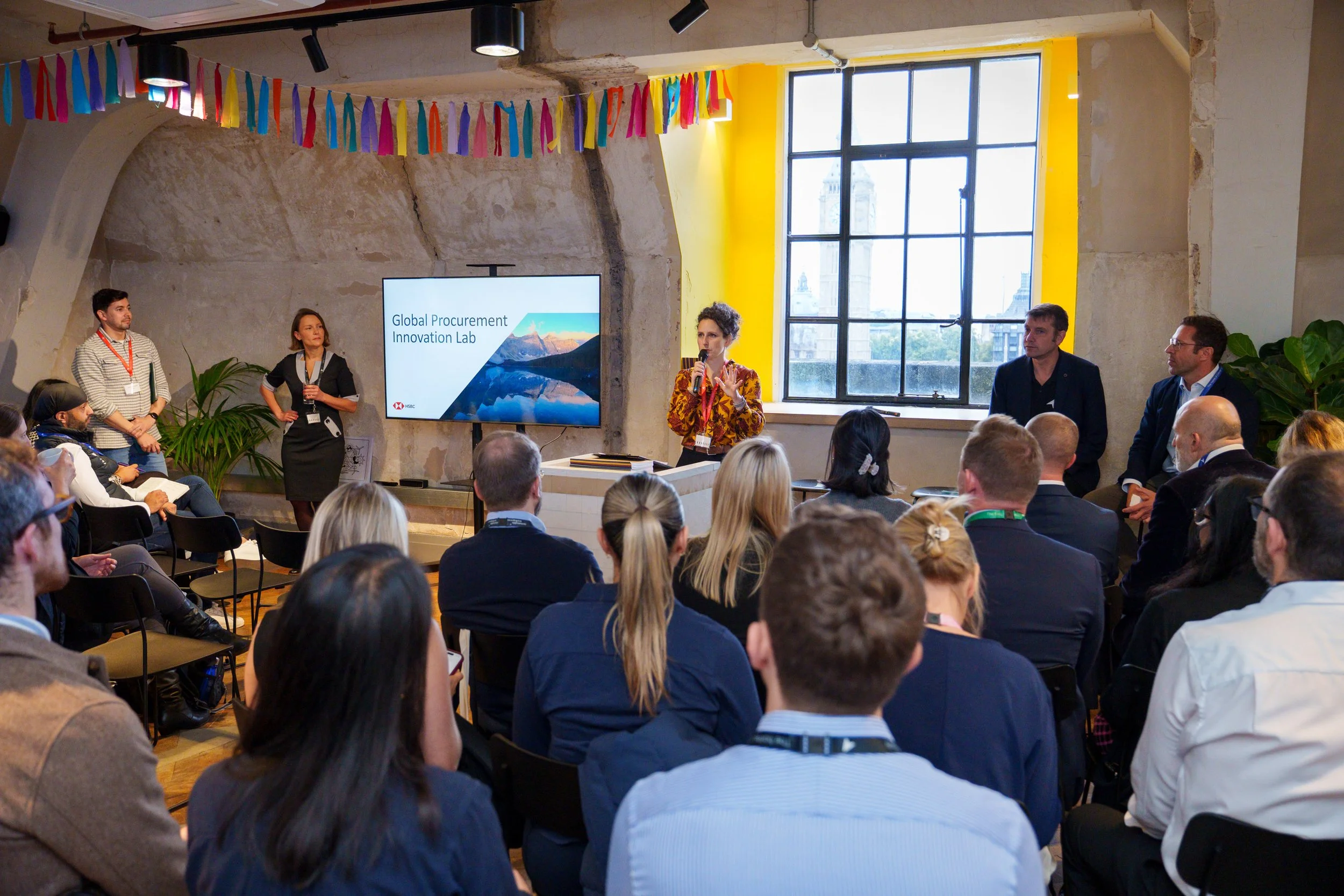
HSBC had the ambition. What they didn't have was a clear line of sight from that ambition to action. Decades of outsourcing had made the supply chain opaque. Carbon data was organised by spend category - useful for procurement, useless for decarbonisation. Nobody could say with confidence what was driving the footprint, which meant nobody could say with confidence how to reduce it.
We designed a three-phase programme - Discovery, Ideation, Strategy. It deliberately ignored traditional procurement categories and focussed instead on root causes. We ran four parallel workstreams simultaneously: carbon footprint assessment, supply base review, external environment scanning, and a procurement readiness assessment.
The last one matters more than it sounds. There's no point designing strategies an organisation can't execute.
We developed a portfolio of category-agnostic decarbonisation opportunities, supplier maturity frameworks, and an implementation roadmap with clear priorities for deploying limited resources where they'd have the greatest impact.
The work surfaced an uncomfortable truth: some of HSBC's established procurement practices - supply base consolidation, outcome-based contracting - were inadvertently making decarbonisation harder. Recognising that created space for more intelligent trade-offs.
HSBC commissioned further work in 2026 to embed the strategy into procurement operations.
THE WORK DIDN’T STOP THERE___
The root-cause methodology we developed for HSBC became the foundation for WAYFINDER, a framework now used across our client base to integrate sustainability into procurement at scale. It also fertilised Need2Know, an AI-driven solution that gives category managers the information they need to know when they need to know it.